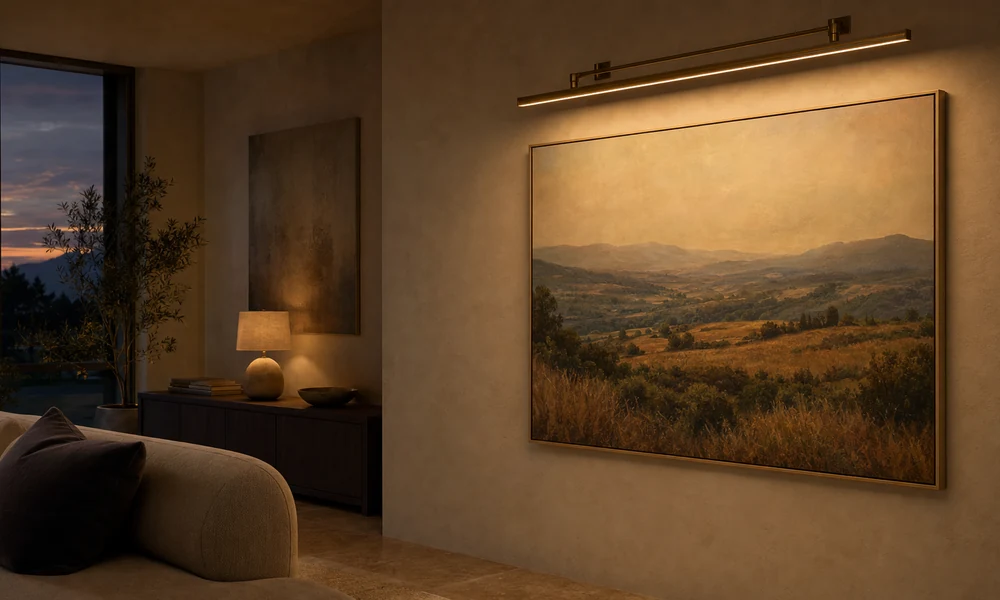
You know the painting. At noon it earns the wall. After six the ceiling can is on, the sofa lamp is on, and the canvas is a dark rectangle with a gilt edge. That is not the art going quiet. That is picture lighting never asked to do its job. Light the face of the work, keep the color honest, and stop the glass from flashing back at you.
This is still layered lighting. The picture light — or the adjustable spot that stands in for one — is the accent layer. Ambient in the room keeps the wall from becoming a cave. A single downlight over the sofa cannot do both.
What picture lighting should do
Picture lighting should wash the artwork evenly, at about 30 degrees from vertical, with a high-CRI warm LED so pigments look like themselves and the reflection misses your eyes. Size the bar to the frame, or aim a spot at the center of the piece. Dim it so the art glows; it should not look like a searchlight.
You do not need a museum meter. You need to stand where you actually look — from the sofa, from the hall — and see the painting, not the lamp.
What is the 30-degree rule?
Aim the beam at the art from about 30 degrees off straight-down. Gallery how-tos treat that angle as the boring compromise that works: enough slope to cover the canvas, not so flat that the fitting appears in the varnish.
A recessed can parked over the frame, firing at 0 degrees, is the usual failure. It hotspots the top, leaves the bottom in a cave, and if there is glass you get a white rectangle in the reflection. Too far into the room and the bounce comes straight at your face.
You can skip the trigonometry. Start a track head or an adjustable spot a short step out from the wall — trade copy often lands around 20 inches, or a little more on a taller ceiling — and look. If you see the lamp in the glass, move it farther out. If the top of the canvas is a shadow, bring it in. For heavy oil texture, some installers flatten the aim a few degrees so light rakes the brushwork instead of sitting on it. Your eyes, at night, are the brief.
A picture light bolted above the frame builds a downward wash into the fitting, so you are not drilling the ceiling. The 30-degree idea still applies: tilt the head until the light reaches the bottom of the work, not only the top third.
Picture light or track?
A bar over one frame is the traditional answer, and it is the right one when you have a single piece, a period room, or no appetite for ceiling work. Plug-in and rechargeable bars exist for walls with no box. Hide the cord or pick a battery fitting and live with charging it.
Track, or a couple of adjustable ceiling spots, is the better answer for a wall of pieces, a collection that moves, or art behind glass. A bar firing down the face is more likely to glare in glazing. Heads on a rail can sit out in the room, hold the 30-degree aim, and get re-aimed when you swap a print. That is the opposite of asking a central ceiling fixture to light a painting it cannot see.
A gallery wall of eight small frames does not want eight picture lights. It wants a wider wash, or a few spots on the hero pieces and a calmer fill on the rest. One tiny spotlight on a wide canvas is how you get a bright belly and dead corners.
This is accent, not sculptural lighting as the object. The fitting should recede. The work should not.
How wide, how high, how bright?
Tape it. Then look at night with the other lamps dimmed.
- Center the bar on the frame. Guides cluster a few inches above the top edge — often about 2 to 6 inches, sometimes closer to 6 or 7. Higher on a tall piece so the beam can travel. Too tight and the frame casts its own shadow.
- Width: about half to two-thirds of the artwork. Too short, bright middle, dull sides. A very wide landscape may want two smaller bars instead of one heroic one.
- Output: home guides do not agree on lumens. Treat brightness as a dimmer problem. If color looks washed and the glass flashes, it is too much. If the piece disappears when the room lamps are on, it is too little. One maker talks about the art reading a bit brighter than the room, not like a stage.
- Deep frames need more air, or a shallower tilt, so the moulding does not eat the top of the image.
Do not shop by a single lumen number. Shop by whether you can aim it, and whether it dims.
CRI, Kelvin, and what fades the work
Color rendering is the spec that actually changes the painting. Household LEDs often sit around CRI 80. For a face on a wall, look for 90 or better so reds do not go brick and blues do not go grey. Kelvin is a different number. In a living room that already runs warm, stay in 2700K to 3000K so the art does not fight the lamps. That is the same warm white vs cool white choice as the rest of the house. A 4000K “gallery” bulb on one wall and 2700K table lamps on the other is how a careful hang looks accidental.
Keep every fitting on that wall in the same Kelvin. ENERGY STAR still prefers the warm residential band in homes. Save cooler light for a studio you actually work in.
Use LED, not leftover halogen, in a picture light. Trade guidance is consistent: halogen brings heat and UV that conservation-minded owners do not want on pigment and paper. Direct sun on the same wall is the other fading machine. Pull the curtain. Do not invent a lux budget from museum tables you have not read.
Glass: dim a notch, soften the tilt, or switch to a ceiling spot at 30 degrees. Non-reflective glazing helps. Standing where you sit is the test, not standing on a ladder.
The usual mistakes
A downlight over the frame. A bar half the width it needs. Cool white on a warm painting. CRI ignored, lumens chased. Lighting the wall around a small print with a flood. All of those are the same error: the fixture as jewelry, the art as an afterthought.
Turn the other lamps down tonight. Stand where you look. Do you see the work, or the lamp in the glass? That is the whole brief.