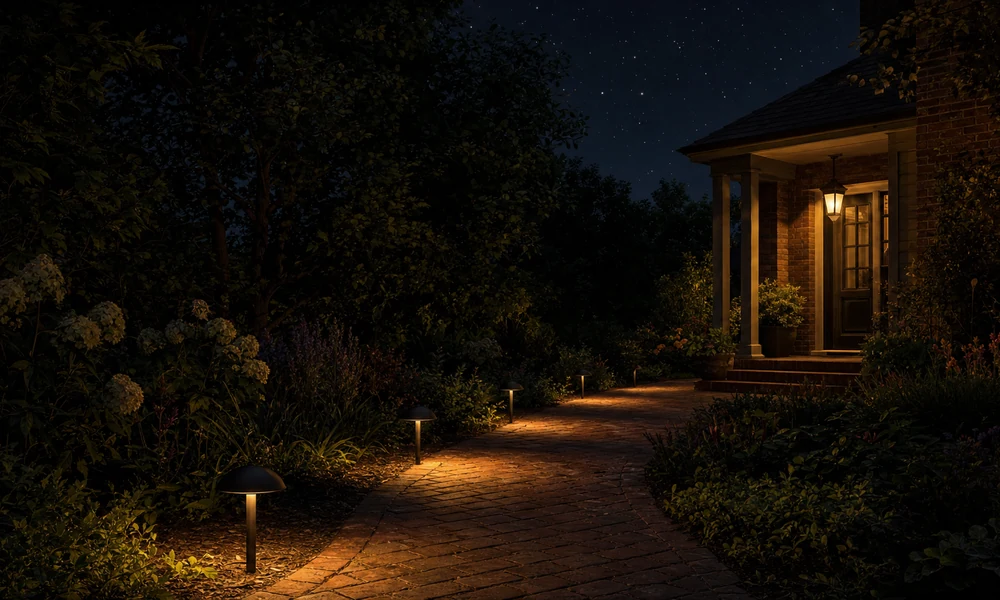
You know the walk. A row of glowing globes, the neighbor’s bedroom in the splash, a sky the color of a parking lot — and you still miss the step by the gate. That is not a dark path. That is outdoor path lighting aimed at everything except the ground. Point it down, keep it warm, and turn it off when you are inside.
This is the outdoor version of layered lighting: enough on the walk to see the brick, a porch light that does not rake the yard, nothing extra in the trees “for drama.” Pretty is allowed. Spill is not the brief.
What outdoor path lighting should do
Outdoor path lighting should put a modest, warm pool on the walking surface, from a fully shielded fixture, and nowhere else. Use 3000K or warmer — 2700K is kinder. Put the run on a timer or a motion sensor so it is not dusk-to-dawn by default.
DarkSky International and the IES boiled that into five principles: useful, targeted, low level, controlled, warm-colored. Light where you need it, when you need it, in the amount needed, and no more. A path is a narrow job. Treat it like one.
Useful and targeted: light the walk, not the sky
Useful means the fixture has a job. If a stake in the flower bed does not help you find the door, pull the lamp. DarkSky’s home checklist starts there: no purpose, no bulb.
Targeted means the beam hits the path and stops. Fully shielded, in their home-lighting language, is a fixture that in its installed position sends all of its light below the horizontal line through the lowest glowing part. You should not see the lamp from the sidewalk. You should not see it from the neighbor’s porch.
The usual path failure is a little globe or an open pagoda. Light goes up, sideways, into eyes, into bedrooms. DarkSky has estimated that a large share of residential outdoor light — they cite a National Park Service range of 20 to 50 percent — goes straight into the sky because the fixture is unshielded. You do not need the percentage to diagnose yours. Stand at the gate. If the lamp is a bright bead, it is not targeted.
What to use instead: a path light with an opaque cap and a downward lens, a mushroom with a solid top, a low bollard that cuts off above the horizontal. Look for the DarkSky Approved seal if you want a third party to have checked. “Dark sky friendly” on a carton is marketing. The seal is a program. Either way, the geometry you can see at night is the test: cap on top, glow on the bricks.
Aim matters as much as the housing. Tilt a “shielded” fixture up to wash a tree and you have invented a flood. Leave tree trunks in the dark. They were not the brief.
How bright is bright enough?
Low level means the least light that lets you see the step. DarkSky’s home page is direct about the safety myth: brighter is not safer, and too much light can work against you. Glare from an unshielded globe makes the rest of the yard look darker. Your eyes adapt to the lamp, not the bricks.
There is no single lumen number worth shopping as law. Trade blogs invent them. Skip the package race. If you can walk the path without squinting, and the neighbor’s siding is not in the splash, you are close. A dimmer or a lower-output lamp is the fix when you overshot. Pale concrete throws more light back at the sky than dark brick — same fixture, more glow — so start dimmer on a light surface.
This is the same instinct as eco-friendly lighting indoors: use what you need. Waste is not a look.
Controlled and warm
Controlled means the path is not a runway from dusk until the newspaper. DarkSky’s home advice: timers on porch and path, occupancy sensors on “security,” and a hard look at why anything is on all night. Their 2020 home-lighting notes call dusk-to-dawn sensors a bad default and suggest motion hold-times of a few minutes, not an hour. You want the walk lit when you come home. You do not want it lit while you sleep.
Warm-colored means less blue-violet in the beam. DarkSky’s purchase line is simple: correlated color temperature 3000K or lower. Their home program calls 2700K or less a good residential option. That is the outdoor half of warm white vs cool white. A 5000K “daylight” path LED will make the garden look like a loading dock, punch through the curtains, and fight every lamp in the house. It also puts more short-wavelength light into a night you were trying to keep.
If you already care about warm light before bed, do not undo it at the window with a cool flood on the walk.
Neighbors, globes, and the porch
Light that leaves your lot is not hospitality. DarkSky’s fully-shielded test includes a practical one: the source should not be visible from beyond the property. If it is in their bedroom, it is in the wrong place. A house-side shield, a lower stake, a warmer lamp, or turning it off after evening traffic will do more than an argument.
The porch lantern with clear glass is the other leak. Same rules: opaque top, downward light, warm lamp, a switch or a timer. One shielded porch fixture plus a short run of path lights will read calmer than eight decorative stakes and a flood on the gable.
Solar stakes are fine as a trial of layout. Many of them are unshielded beads. If they throw light up, they fail the same test as the wired globes. Do not confuse “no wire” with “no spill.”
You do not need an ordinance to walk the yard. If your town has one, read it. Do not assume every suburb requires a DarkSky seal.
The usual mistakes
Globes. Cool white. Dusk-to-dawn at full blast. Uplights in the trees “because landscape.” A flood as a path light. All of those are the same error: lighting the night, not the walk.
Go outside after dark with the interior lamps as they usually are. Where does the light actually land — on the bricks, in the sky, or in the next window? That is the whole brief.