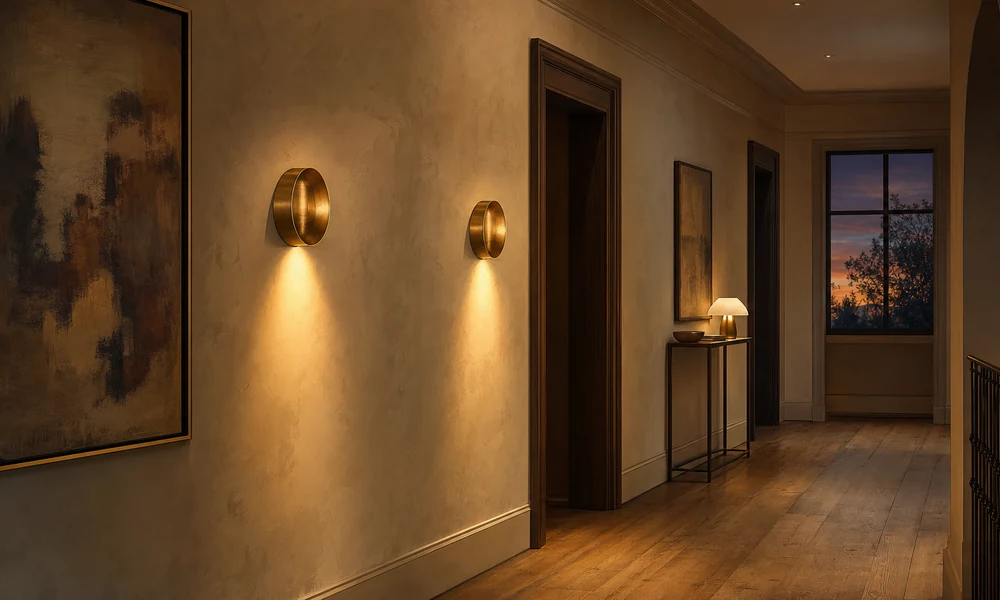
You know the hall. One ceiling can, a long plaster run, and after six the walls are still a cave. Or the opposite: a pair of wall sconces so high they light the crown molding, and you walk through a tunnel of scalp light. Hang them where a person is. Space them. Then walk past before anyone cuts a box.
This is still layered lighting. The sconce is the wall layer — ambient in a hall, a little glow beside a fireplace, task at the bed. It is the practical answer to a single ceiling fixture doing every job from the middle of the room.
What wall sconces should do
Wall sconces should light the wall plane at about standing eye height, not the ceiling and not your retinas. For a hallway or living room, start with the center of the fixture 60 to 66 inches off the finished floor. Space a run about 6 to 10 feet apart. Sit down before you copy that number onto a headboard.
ENERGY STAR treats a sconce as a wall light that is not trying to be a picture wash or a vanity task lamp. That is useful. It means the job is the room you walk through, not a catalog of arms and globes.
Pretty is allowed. Pretty is not the test.
How high should a wall sconce hang?
Trade guides agree on a band, not a sacred number. Measure from the finished floor to the center of the fixture — or to the lamp if the backplate sits low and the shade sits high.
On an ordinary 8-foot hall, 60 to 66 inches is the start. This Old House opens the accent band a little wider, 60 to 72. Go much under 60 and a bare bulb meets you at the eyes. Go much over 66 and the light lifts off the people and starts decorating the plaster.
If the ceiling is 9 or 10 feet, you can bump a couple of inches so the fixture still relates to the door casings. Do not chase the plaster. A sconce that belongs to the ceiling has already failed the walk-past test.
Shade opacity matters more than the tape. A milk-glass or fabric shade can sit nearer eye level without hurting. A clear globe or an exposed lamp wants to miss your sightline, or it wants a different fixture.
Tape a paper plate at the planned center. Walk the hall both ways, in the shoes you actually wear. If you look into a lamp, move it, shield it, or pick a shade.
How far apart in a hallway?
Even pools beat an exact inch. Start around 6 to 10 feet on center — many hallway guides tighten that to 8 to 10 — and then look at the wall you actually have.
Doors, closets, and a window will wreck a mathematical grid. Plan the empty stretches first. Leave about 6 to 12 inches from a door casing or an inside corner so the shade is not kissing the trim.
Guides wander, so treat these as a tape-out:
- Under about 6 feet of hall, one sconce or the ceiling light may be enough. Do not force a pair.
- A medium run, roughly 12 to 20 feet, often wants two or three, adjusted around openings.
- Twelve feet between fixtures is the usual dark-stretch complaint. If you can see a hole in the wash, you are too thin, not too tasteful.
- A narrow hall, about 36 to 48 inches, usually wants one wall — the uninterrupted one. Both sides crowd the walk and the laundry basket.
- A wider hall or foyer can take both walls, or a stagger so you are not marching between matching pairs.
Projection is a clearance problem. A deep globe that looks modest from the front still occupies the path. In a tight passage, pick a shallow body.
Bedside is a different number
Copying hallway height onto a headboard is how you light the ceiling and miss the book.
This Old House puts sconces around a headboard at 48 to 60 inches from the floor. Other guides measure from the mattress — roughly 20 to 36 inches above the top, or a few inches above a tall headboard. The inches disagree. The tests do not.
Sit where you read. The switch should be reachable without a full sit-up. The beam should hit the page, not the opposite pillow. You should not see into a bare lamp with your head down. If the arm swings, make sure it clears the headboard and the person getting in.
A decorative pair that only glows is allowed. Call it ambient and keep a reading lamp. Do not pretend a hallway sconce is a task light because it is brass.
Flanking a bathroom mirror is another job entirely. That is vanity lighting — even light on a face, not a hall wash. Point the electrician at that piece and come back.
Hardwired or plug-in?
Hardwired needs a box in the wall at the height you already chose. New boxes are electrician work. The result is a clean backplate and a wall switch, which is what you want on a hall you walk in the dark.
Plug-in sconces are the rental and retrofit move. Bracket, cord, nearby outlet. Same lamp, same brightness. The cord is the whole difference. A cover painted with the wall helps. It will not fool anyone in a formal room, and it does not have to. We use the same honesty in a small apartment with no rewiring.
Decide the switch before the hole. A hall wants the sconce on the way in, not only on a pull chain at the far end. A bedside pair wants a switch you can reach from the pillow, not only the door.
Kelvin, glare, and a dimmer
Match the rest of the house. ENERGY STAR builder guidance prefers 2700K to 3000K in homes, with CRI 80 or better. A 4000K hall next to a 2700K living room is how an expensive paint job looks unfinished.
A dimmer turns “find the bathroom” and “leave a night glow” into different scenes. If the LEDs flicker, the dimmer and the lamp are mismatched. Check the list before you blame the shade.
Exposed lamps in a walking path are a glare problem no dimmer fully fixes. Shield them, raise or lower a few inches, or pick a fixture that hides the source.
The usual mistakes
Mounting by habit at 72 inches because that is where the painter’s tape felt safe. Copying hallway height onto the bed. Spacing a 20-foot hall with two sconces and calling the dark stretches “rhythm.” Pairing a deep arm into a 36-inch passage. Skipping the walk-past.
Tape the centers tonight. Walk it. Where does the wall still disappear — between fixtures, or in your eyes? That is the whole brief.